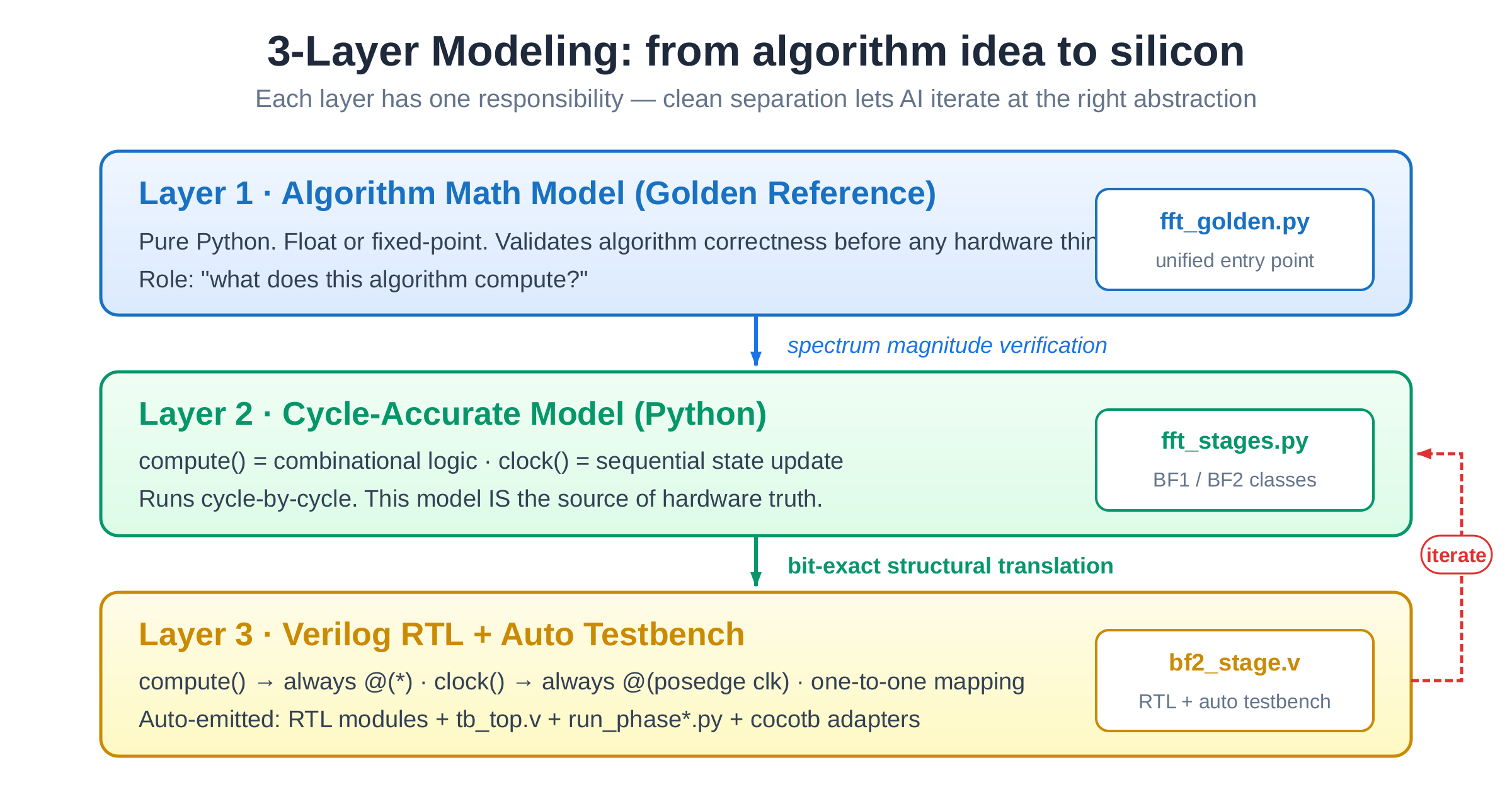
Each core family is produced by a parameterized generator: change the
code parameters and a new, bit-exact decoder or pipeline is emitted and re-verified
automatically. These are the verified building blocks we deploy into real systems. You
license proven silicon, and the ability to re-target it in days.
Wireless PHY
802.11a Wi-Fi RX · OFDM
A complete 802.11a Wi-Fi receiver physical layer: synchronization, OFDM
demodulation, equalization, soft demapping, and Viterbi decoding. A MATLAB-generated
standard waveform is recovered bit-for-bit on a fingernail-sized FPGA.
End-to-end recovery0 errors MEASURED
Receive clock (Zynq-7010)162.7 MHz MEASURED
Line rate54 Mbps MEASURED
Wireless PHY family
Cellular PHY
5G NR SSB RX · cell search
A 5G NR cell-search receiver: primary-synchronization detection, SSB extraction, a
256-point OFDM demodulation, and the full broadcast decode to the Master Information
Block. Three real over-the-air cells are read to a consistent broadcast message.
Real cells decoded3 / 3 CRC clean MEASURED
Detector vs earlier HLS38% fewer LUTs MEASURED
Receive clock (KV260)256 MHz MEASURED
Cellular PHY family
LDPC Decoders
5G NR · IEEE 802.11n · CCSDS
Layered and folded QC-LDPC decoders for 3GPP 5G NR (BG1/BG2, all lifting sizes),
Wi-Fi, and CCSDS AR4JA deep-space links. Syndrome-based early termination,
zero DSP usage, single-CNU area class.
Clock (5G NR, xcku13p)463 MHz MEASURED
Throughput (early-stop)>1 Gbps MEASURED
DSP blocks0
LDPC family
Viterbi Decoder
convolutional FEC · Wi-Fi · DVB · LTE · satellite
A soft-decision Viterbi decoder for rate-1/2 convolutional codes, K=7 and K=9.
One decoded bit per clock, zero DSP, and open RTL verified bit-for-bit against the
reference decoder, where the common commercial core ships encrypted.
Clock (K=7, UltraScale+)527 MHz MEASURED
Throughput527 Mbps MEASURED
DSP blocks0
Viterbi decoder
DSP Pipelines
FFT · FIR · CIC · NCO/DDS
Streaming FFT engines (1k–8k points) and a 58-variant FIR filter family:
symmetric, systolic, multi-channel TDM, polyphase resamplers, digital
up/down-conversion chains. One sample per clock, every clock.
FFT clock (1k–8k)404–446 MHz MEASURED
FIR clock (peak)485 MHz MEASURED
Initiation intervalII = 1
DSP family
Trading Systems
Limit order book · market data
A hardware limit-order-book builder processing one exchange message per clock
cycle, verified bit-exact against real NASDAQ market-data replay. Hierarchical
symbol caching scales to full-market coverage.
Pipeline clock361 MHz MEASURED
Hot-path latency11 cycles MEASURED
Wire-to-wire130 ns TARGET
Trading family
Quantum LDPC
QEC decoding · in development
Relay belief-propagation decoder for quantum error correction on
bivariate-bicycle codes (the IBM "gross" code). FPGA-pipelined BP iteration
already clocking past the published reference implementation.
BP iteration clock118 MHz MEASURED
Published reference83 MHz
StatusIN DEVELOPMENT
qLDPC program